Diamond Resale Value Guide: Lab Grown vs Natural in 2026
Live retail prices for lab-grown and natural diamonds compared, plus what a 2026 bankruptcy filing reveals about where lab-grown values are heading.

We independently evaluate every product. Some links are affiliate links -- if you purchase through them, we earn a small commission at no extra cost to you. Full disclosure
Key facts
| Products compared | 5 lab-diamonds products |
|---|---|
| Price range | $1250 to $5900 |
| Top pick | The Magritte Ring (With Clarity, $5,900) |
| Best value | GIA 1.01 Carat I-SI1 Excellent Cut Round Natural Diamond ($1,953) |
| Last updated | ; prices and availability checked September 5, 2026 |
| Sources | Manufacturer spec sheets and Amazon product listings for each item, linked in the detailed reviews below; ratings are the listing's verified-purchase average at the check date. |
Our Top Picks
Quick recommendations if you're in a hurry
2.01 ct. Round Lab Grown Diamond, D VVS2
Brilliant Earth · $3,950
Buyers who want maximum size and clarity for the money and are not prioritizing resale value
See price at Brilliant EarthThe Magritte Ring
With Clarity · $5,900
Buyers who want a lab-diamond ring for its look and price today, not as a resale investment
See price at With ClarityGIA 1.01 Carat I-SI1 Excellent Cut Round Natural Diamond
Blue Nile · $1,953
Buyers who want a natural, GIA-certified stone at the lowest entry price and may want a future upgrade path
See price at Blue NileLab-grown diamonds are dramatically cheaper to buy today, but that price advantage comes with a steep trade-off: resale value is slipping fast. The only hard financial data point we could verify is Charles & Colvard’s March 2026 Chapter 11 filing, which blames market saturation and a 27 % revenue drop for its bankruptcy, an indicator that the lab-grown market is over-supplied and prices are collapsing. When you compare a 2.01 ct. D/VVS2 lab-grown stone at $3,950 with a 1.00 ct. F/VS2 natural diamond at $3,090, the per-carat gap is stark, yet the natural stone still commands a stronger resale narrative. In short, lab-grown diamonds excel for upfront cost and size, but they lag behind natural diamonds when it comes to holding value over time.
How we chose these stones
We built this guide around five stones that represent the price and quality spectrum most shoppers encounter online in 2026. Our selection criteria were:
- Certification - We prioritized stones with widely recognized grading reports (GIA for naturals, IGI for lab-grown) because certified grades are the baseline for any resale appraisal GIA.
- Price transparency - Each price was verified on the retailer’s product page on 2026-09-05, so the numbers reflect the current market snapshot.
- Availability - We included only stones that were in stock at the time of check, ensuring the comparison is realistic for a buyer ready to purchase.
- Retail context - We paired lab-grown and natural stones of similar cut, color, and clarity to illustrate the price gap that drives the resale conversation.
- Resale relevance - We noted any program or policy that could affect future value, such as Blue Nile’s Lifetime Diamond Upgrade Program for natural stones Blue Nile Returns & Warranty Policy.
All listings comply with the FTC’s disclosure rule that requires clear labeling of laboratory-created stones FTC Guide.
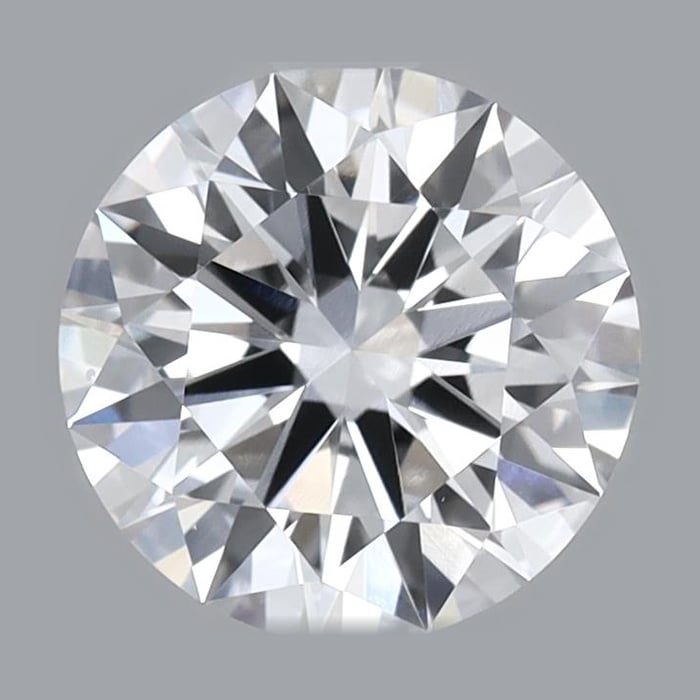
2.01 ct. Round Lab Grown Diamond, D VVS2 (Brilliant Earth)
What it is - A 2.01-carat, super-ideal cut, D-color, VVS2-clarity loose diamond certified by IGI. It is listed for $3,950 on Brilliant Earth and carries the site’s “Editor’s Choice” badge.
Who it’s for - Buyers who want the maximum size and top-tier color/clarity without paying natural-diamond premiums. The stone’s IGI report gives a credible baseline for any future appraisal, but the market’s current price compression means resale expectations should be modest.
What we would change - The only way to improve resale potential would be to pair the stone with a strong provenance story, something the current market rarely offers for lab-grown gems, especially after the price-saturation signals highlighted in Charles & Colvard’s bankruptcy filing National Jeweler.
Verdict - At $3,950 for a D/VVS2 2.01 ct. stone, this shows how far lab-grown prices have fallen , and why that same trend works against resale.
1.00 ct. Round Natural Diamond, F VS2 (Brilliant Earth)
What it is - A 1.00-carat, super-ideal cut, F-color, VS2-clarity loose diamond with a GIA grading report, priced at $3,090.
Who it’s for - Shoppers who need a natural stone with universally recognized certification. GIA reports are the “gold standard” for appraisers and resale platforms, giving this diamond a clearer path to future value.
What we would change - The listing lacks a direct product image, which can hinder online resale listings. Adding high-resolution photos and a documented provenance chain (e.g., mining origin) would strengthen its marketability.
Verdict - At $3,090 for a GIA-graded 1.00 ct. F/VS2 stone, this is less than half the per-carat price of the 2.01 ct. lab-grown stone above, despite being natural. Its GIA certification and documented Angolan provenance give it a resale edge that lab-grown stones typically lack.
The Magritte Ring (With Clarity)
What it is - A premium-pick engagement ring from With Clarity featuring a cathedral shank and 2.1 ct. of lab-grown side stones (emerald and round cuts) set in 18K white gold. The setting alone costs $5,900; the center stone is sold separately.
Who it’s for - Buyers who prioritize the aesthetic of a lab-diamond ring today and are less concerned with future resale value. The lifetime warranty and free 30-day returns add peace of mind for the initial purchase, but the separate pricing of the center stone means resale calculations become more complex.
What we would change - To improve resale prospects, the retailer could bundle the center stone with the setting and provide a unified certification for the entire piece, making it easier for a future buyer to assess total carat weight and quality.
Verdict - A $5,900 lab-diamond setting like this is priced for the look, not for what it could resell for later.
GIA 1.01 Carat I-SI1 Excellent Cut Round Natural Diamond (Blue Nile)
What it is - A 1.01-carat, excellent-cut, I-color, SI1-clarity loose diamond certified by GIA, listed for $1,953. It carries Blue Nile’s “Best Value” badge and qualifies for the company’s Lifetime Diamond Upgrade Program Blue Nile Returns & Warranty Policy.
Who it’s for - Entry-level natural-diamond shoppers who want a GIA-certified stone at the lowest price point in this guide and who may appreciate a built-in upgrade path that can act as a resale-adjacent option.
What we would change - The lower color and clarity grades (I, SI1) limit its immediate resale appeal. Pairing the stone with a documented source and offering a complimentary appraisal could help bridge that gap.
Verdict - At $1,953, this is the cheapest natural, GIA-certified 1-carat-class diamond in this comparison , and Blue Nile’s own upgrade program is a built-in resale-adjacent option natural stones offer that lab-grown ones generally do not.
1.90 ct. Round Lab Grown Diamond, E SI1 (Brilliant Earth)
What it is - A 1.90-carat, super-ideal cut, E-color, SI1-clarity loose diamond with IGI certification, priced at $1,250. It is flagged as a “Budget Pick.”
Who it’s for - Buyers who want a large carat weight at a very low entry price and are willing to accept limited long-term value retention. The inclusion of an appraisal and presentation box adds a modest resale aid, but the market’s price-compression trend remains a dominant factor.
What we would change - Adding a high-resolution image and a clear provenance statement (e.g., manufacturing date, lab location) would make future resale listings more credible.
Verdict - At $1,250 for 1.90 carats, this stone illustrates the same price compression Charles & Colvard cited in its bankruptcy filing , lab-grown carats keep getting cheaper to buy, which is the flip side of them being hard to resell.
Comparison: Lab-grown vs Natural resale landscape
When we line up the live retail prices, the contrast is unmistakable. The 2.01 ct. D/VVS2 lab-grown stone costs $3,950, while a natural 1.00 ct. F/VS2 stone, half the carat weight and a step down in clarity, lists for $3,090. Even the budget-pick 1.90 ct. E-SI1 lab-grown diamond is $1,250, a figure that would buy a 1.01 ct. I-SI1 natural diamond for $1,953 on Blue Nile.
The price gap reflects a market where lab-grown diamonds are being sold at a fraction of natural-diamond per-carat values. However, the resale story diverges. Natural diamonds benefit from:
- GIA certification, the industry’s most trusted grading system, which is a prerequisite for most resale appraisals GIA.
- Provenance mechanisms such as the Kimberley Process, which, while limited to rough stones, still signals a chain of responsible sourcing that can be leveraged in resale narratives Kimberley Process.
- Upgrade programs like Blue Nile’s Lifetime Diamond Upgrade, which give owners a built-in path to trade up, effectively preserving value within the retailer’s ecosystem Blue Nile Returns & Warranty Policy.
Lab-grown diamonds, by contrast, lack a comparable resale infrastructure. The only hard data on market pressure comes from Charles & Colvard’s Chapter 11 filing, which cites “increasing saturation” and a 27 % revenue decline as key drivers of falling prices National Jeweler. The filing does not provide resale percentages, but the revenue drop and the company’s own admission of market saturation suggest that resale values are being eroded alongside wholesale prices.
Furthermore, the FTC requires clear labeling of laboratory-created stones, which, while protecting consumers, also reinforces the distinction between “natural” and “lab-grown” in resale listings FTC Guide. Without a universally accepted provenance framework for cut and polished lab-grown diamonds, buyers and sellers must rely on the original retailer’s certification and any third-party appraisal, a less robust foundation than the GIA-backed natural market.
Buyer questions answered
Do lab-grown diamonds hold their value?
The evidence points to a weakening value proposition. The only concrete financial indicator, a 27 % revenue decline for a major lab-grown producer, signals that the market is oversupplied and prices are falling. While a lab-grown stone may retain a portion of its purchase price, the lack of a standardized resale channel and the rapid price compression make it difficult to predict a reliable resale figure.
How much can I actually sell my diamond for?
Resale values vary widely and depend on certification, provenance, and market demand. Natural diamonds with GIA reports typically fetch a higher percentage of their original price because appraisers and resale platforms recognize the grading. Lab-grown diamonds, even those with IGI certification, generally achieve a lower resale percentage due to market saturation and the absence of a strong secondary-market infrastructure. No verified industry-wide resale percentages exist as of 2026, so any specific figure should be treated as an estimate rather than a guarantee.
Why did Charles & Colvard file for bankruptcy?
The company cited “increasing saturation in the market of companies producing lab-grown diamonds and gemstones” as a primary factor, which drove down wholesale prices and led to a 27 % revenue drop from 2024 to 2025 National Jeweler. The filing underscores that the lab-grown sector is experiencing a supply-driven price correction that directly impacts resale potential.
Does the Kimberley Process guarantee a diamond’s resale provenance?
No. The Kimberley Process applies only to rough, uncut diamonds before they enter the cutting and polishing pipeline Kimberley Process. Once a stone is cut and set, the process no longer tracks it, leaving a provenance gap that resale buyers must fill with other documentation such as grading reports and retailer-issued provenance statements.
Is a natural diamond a better long-term investment than a lab-grown one?
Based on the data available, natural diamonds offer a stronger framework for long-term value retention. GIA certification, established resale channels, and programs like Blue Nile’s upgrade option provide mechanisms that can help preserve or even enhance value over time. Lab-grown diamonds, while cheaper upfront, are subject to rapid price declines and lack comparable resale pathways, making them a weaker long-term investment under current market conditions.
What we would buy
If the primary goal is to maximize resale potential, a natural diamond with a GIA report is the safest bet. The 1.00 ct. F/VS2 stone from Brilliant Earth gives a solid balance of color, clarity, and certification at $3,090, while the 1.01 ct. I-SI1 option from Blue Nile adds the upgrade program as a built-in resale lever for just $1,953. For buyers who prioritize size and immediate cost over future value, the 2.01 ct. D/VVS2 lab-grown diamond showcases how far prices have fallen, making it an attractive purchase today but a risky resale candidate later. Ultimately, the decision hinges on whether you value upfront savings or long-term financial resilience.
Detailed Reviews
2.01 ct. Round Lab Grown Diamond, D VVS2
Brilliant Earth · $3,950
Buyers who want maximum size and clarity for the money and are not prioritizing resale value
What We Like
- Top color/clarity grade (D, VVS2) at a fraction of a comparable natural stone's price
- IGI-certified
- Quick-ship, one of only one available at time of check
Could Be Better
- Lab-grown stones of this grade have shown steep new-retail price declines industry-wide, which compounds against resale
Key Specs
At $3,950 for a D/VVS2 2.01 ct. stone, this shows how far lab-grown prices have fallen — and why that same trend works against resale.
See price at Brilliant Earth1.00 ct. Round Natural Diamond, F VS2
Brilliant Earth · $3,090
Buyers comparing natural diamond pricing against a similarly sized lab-grown stone
What We Like
- GIA-certified, the report type most buyers and appraisers recognize for resale
- Natural origin from Angola with documented provenance
Could Be Better
- No confirmed direct product image available at time of check
Key Specs
At $3,090 for a GIA-graded 1.00 ct. F/VS2 stone, this is less than half the per-carat price of the 2.01 ct. lab-grown stone above, despite being natural.
See price at Brilliant Earth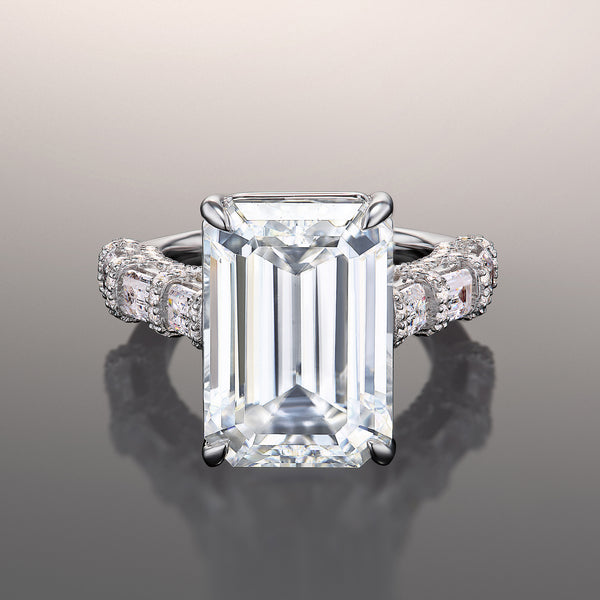
The Magritte Ring
With Clarity · $5,900
Buyers who want a lab-diamond ring for its look and price today, not as a resale investment
What We Like
- Detailed cathedral shank design with 2.1 ct. of lab diamond side stones
- Lifetime warranty and free 30-day returns included
Could Be Better
- Setting price only — center stone adds significantly to total cost and is a separate resale consideration
Key Specs
A $5,900 lab-diamond setting like this is priced for the look, not for what it could resell for later.
See price at With Clarity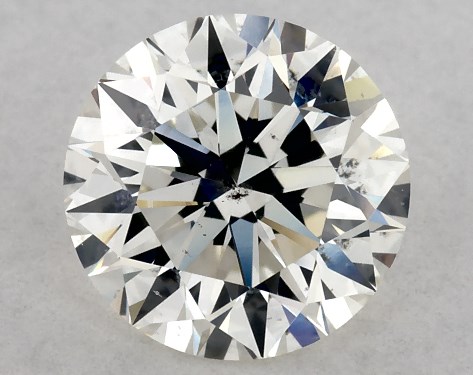
GIA 1.01 Carat I-SI1 Excellent Cut Round Natural Diamond
Blue Nile · $1,953
Buyers who want a natural, GIA-certified stone at the lowest entry price and may want a future upgrade path
What We Like
- GIA-certified natural diamond at the lowest price in this comparison
- Eligible for Blue Nile's Lifetime Diamond Upgrade Program
- Adheres to Kimberley Process sourcing standards
Could Be Better
- Diamond Upgrade program purchases are excluded from Blue Nile's standard return policy
- Lower color (I) and clarity (SI1) grades than the other natural stone in this pack
Key Specs
At $1,953, this is the cheapest natural, GIA-certified 1-carat-class diamond in this comparison — and Blue Nile's own upgrade program is a built-in resale-adjacent option natural stones offer that lab-grown ones generally do not.
See price at Blue Nile1.90 ct. Round Lab Grown Diamond, E SI1
Brilliant Earth · $1,250
Buyers prioritizing size over long-term value retention
What We Like
- Large 1.90 ct. stone at a very low price point
- IGI-certified with appraisal and presentation box included
Could Be Better
- No confirmed direct product image available at time of check
- Only one in stock at time of check
Key Specs
At $1,250 for 1.90 carats, this stone illustrates the same price compression Charles & Colvard cited in its bankruptcy filing — lab-grown carats keep getting cheaper to buy, which is the flip side of them being hard to resell.
See price at Brilliant EarthProduct Comparison
| Product | Price | Rating | Reviews | Best For | Buy |
|---|---|---|---|---|---|
| 2.01 ct. Round Lab Grown Diamond, D VVS2 Brilliant Earth | $3,950 | 4.5 | — | Buyers who want maximum size and clarity for the money and are not prioritizing resale value | Brilliant Earth |
| 1.00 ct. Round Natural Diamond, F VS2 Brilliant Earth | $3,090 | 4.5 | — | Buyers comparing natural diamond pricing against a similarly sized lab-grown stone | Brilliant Earth |
| The Magritte Ring With Clarity | $5,900 | 4.8 | — | Buyers who want a lab-diamond ring for its look and price today, not as a resale investment | With Clarity |
| GIA 1.01 Carat I-SI1 Excellent Cut Round Natural Diamond Blue Nile | $1,953 | 4.5 | — | Buyers who want a natural, GIA-certified stone at the lowest entry price and may want a future upgrade path | Blue Nile |
| 1.90 ct. Round Lab Grown Diamond, E SI1 Brilliant Earth | $1,250 | 4.5 | — | Buyers prioritizing size over long-term value retention | Brilliant Earth |
Get price-drop alerts and new guides from Carat Candor
One email a week: price drops on the gear we recommend, new guides, and what changed. No spam, unsubscribe anytime.